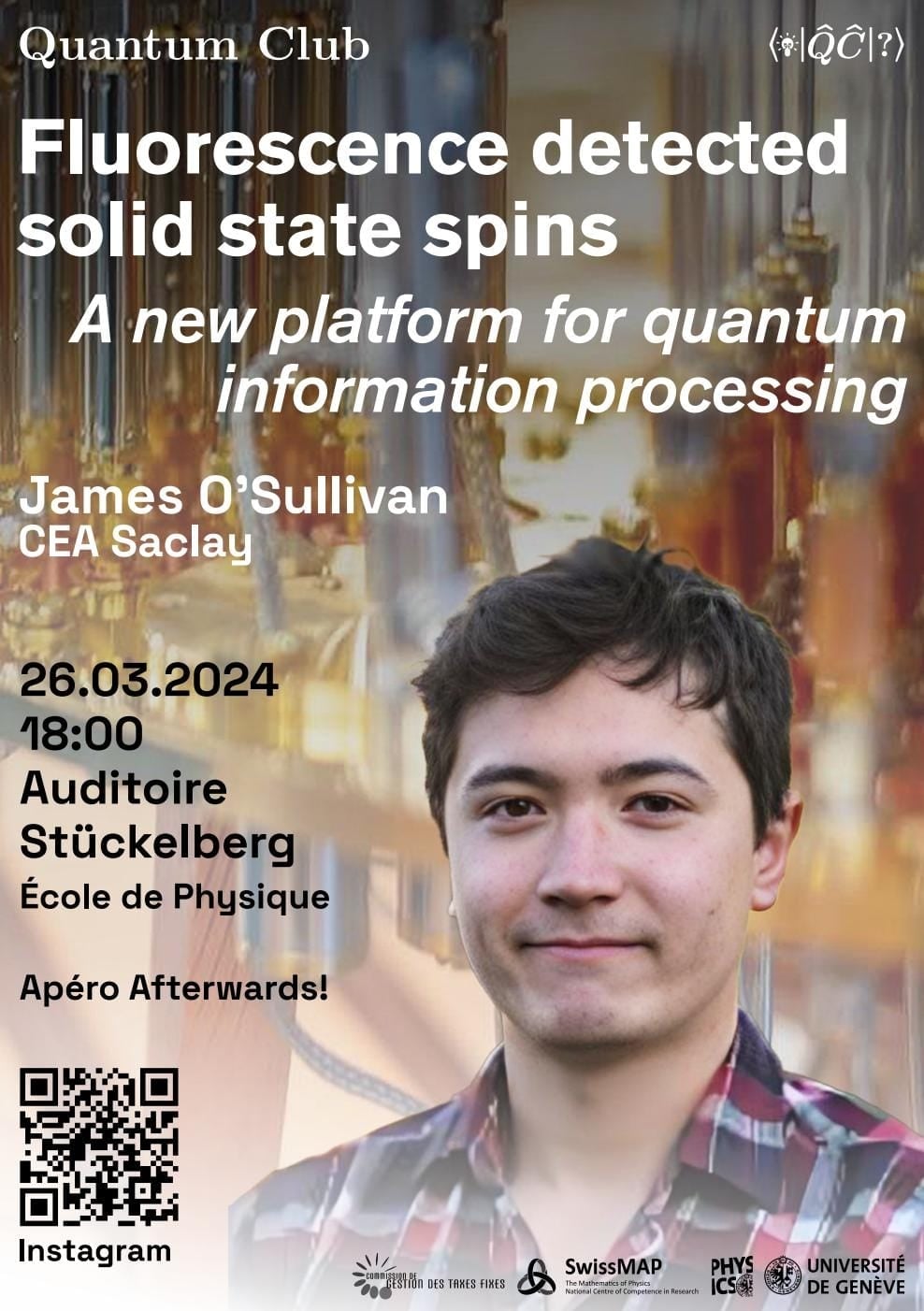
Fluorescence detected solid state spins: A new platform for quantum information processing
About this event
Abstract
Realizing universal fault-tolerant quantum computation presents an immense challenge. One platform that has enjoyed remarkable success towards this is the field of superconducting quantum devices, known collectively as circuit Quantum Electrodynamics (cQED). However, limited qubit lifetimes and rapidly increasing engineering complexity when scaling up to hundreds or thousands of qubits remains an outstanding challenge. An alternative approach is to leverage the advantages of multiple platforms in a hybrid architecture. I will talk about how we can control, couple and reading out solid state spin qubits utilizing a superconducting transmon-based single microwave photon detector to detect the fluorescence of single spin decay via a superconducting resonator. The goal is to develop and extend this novel quantum information processing platform, leveraging the advanced cQED toolkit and the high qubit density and remarkably long coherence times offered by spins, which can exceed seconds.
Event Information
person
Dr. James O’Sullivan,
Université de Genève
schedule 2024-03-26 18:00:00
location_on Ecole de Physique, auditoire Stückelberg
language English